

With this post, we continue our statistical analysis of world athletics, focusing on the Sprints. We hope you find it of interest.
The data are presented in Google Data Studio, allowing readers to select and filter the information. The tool is publicly available and free to access.
We include interactive results tables too that can be filtered directly by different criteria, while Google Data Studio is used for charts and maps.
The underlying data have been collected from the European Athletics website, and World Athletics. Additional sources have been consulted to complement the study.
We hope you find the content interesting.
OVERVIEW
Objective of the Analysis
The aim of the analysis is to provide a historical overview of Sprints events, showing results and participation by athletes and countries, while also benchmarking performance against other athletics disciplines.
Methodology
The report, created in Google Data Studio (Looker Studio), allows the data to be segmented by several parameters, including countries, time period, gender, and so on. This makes it possible to perform different comparisons by applying the appropriate filters and analysing the data from the desired perspective.
The report contains four pages, which can be accessed by clicking the titles in the top navigation bar.
Although the layout adapts to the viewing interface, we recommend using a computer or, at least, a tablet for the best viewing experience.
Interactive Tables
The tables shown in the post are interactive and can be filtered using the drop-down menus in the header. They provide a quick overview of performances, athletes, and countries.
Data selection criteria
For the results, data were collected for all athletes who scored more than 1,100 Hungarian points in the world rankings. For events where there were fewer than 50 athletes per year scoring more than 1,100 points, the top 50 athletes were selected. The aim is to obtain a representative sample, by country, of the number of high-level athletes, without disadvantaging events with lower scoring potential. Of course, this approach assumes that Hungarian points provide a perfectly balanced comparison between performances in different events, which may be a rather strong assumption.
It is important to note that, in all cases, only each athlete’s best performance has been selected. Therefore, each athlete appears only once in any given ranking, based on their personal best.
The analysis period covers 2001 to 2025. However, to provide a more complete picture, world-record data from any date have also been included.
SPRINTS TOP 20 RESULTS TABLE
The table shows all performances by athletes included under the selection criteria mentioned above, from 2001 to 2025. The Gender, Country, and Event filters can be used to narrow down the results. The table displays 20 results per page, ordered from best to worst; you can change pages using the controls below the table.
| Year | Athlete | Gender | Country | Event | Mark | Result HP |
|---|
REPORT PAGE I : HURDLES IN WORLD ATHLETICS 2001-2025
The first page of the report presents information on world records and the top 20 performances for each event, the progression of results across the three sprint disciplines, and results by country.
Access to the report (Page I): https://datastudio.google.com/s/jn6vtUeX-U8
Data Selection Controls
At the top of the report, you will find dropdown controls, in this page Country, Gender & Year selection are included, so the information displayed in all subsequent tables and charts will be affected in case of filtering

The drop-downs allow you to select one, several or all available options intuitively. The report automatically updates to reflect the selected data.
You can also filter the information by clicking directly on data points in most of the charts and tables throughout the report.
All Time World Records & TOP 20 historical results
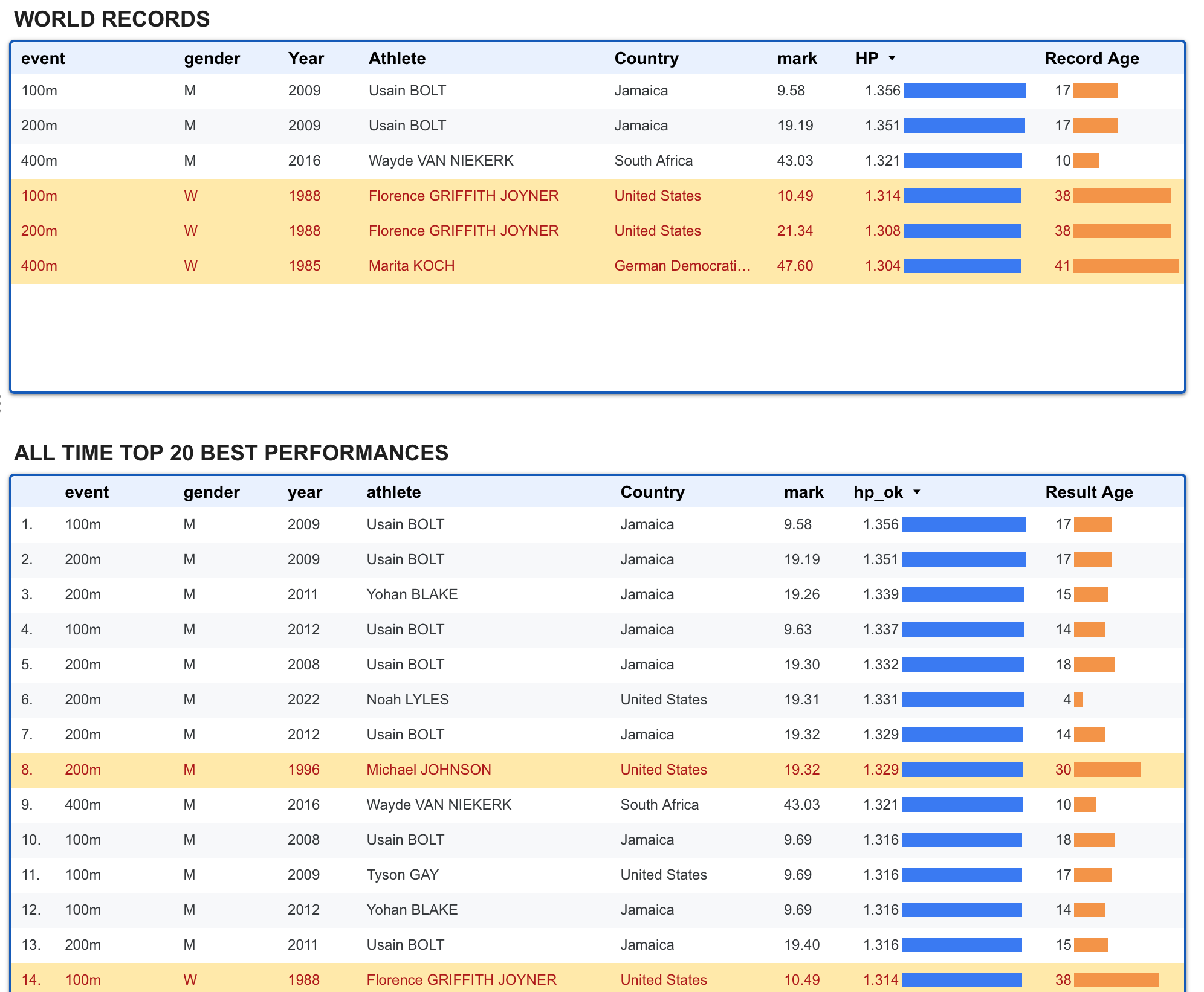
The first chart shows the current records for each event, including the performance expressed in Hungarian points (HP) and the age of each record.
The second chart shows the top 20 all time performances ranked by Hungarian points. Each athlete appears only once per year, based on their best performance. In both lists, performances recorded before 2000 are highlighted in orange.
We can see that the world records in all three women’s sprint events date back to the last century, a “dark” era associated with suspicions of prohibited substance use. The same is not true for the men’s events, where Usain Bolt holds the 100 m and 200 m world records, both set in the first decade of the 21st century.
(Remember that you can filter the data using the dropdown menus above, or by clicking on data points in most charts and tables)
2001-2025 Performance Evolution
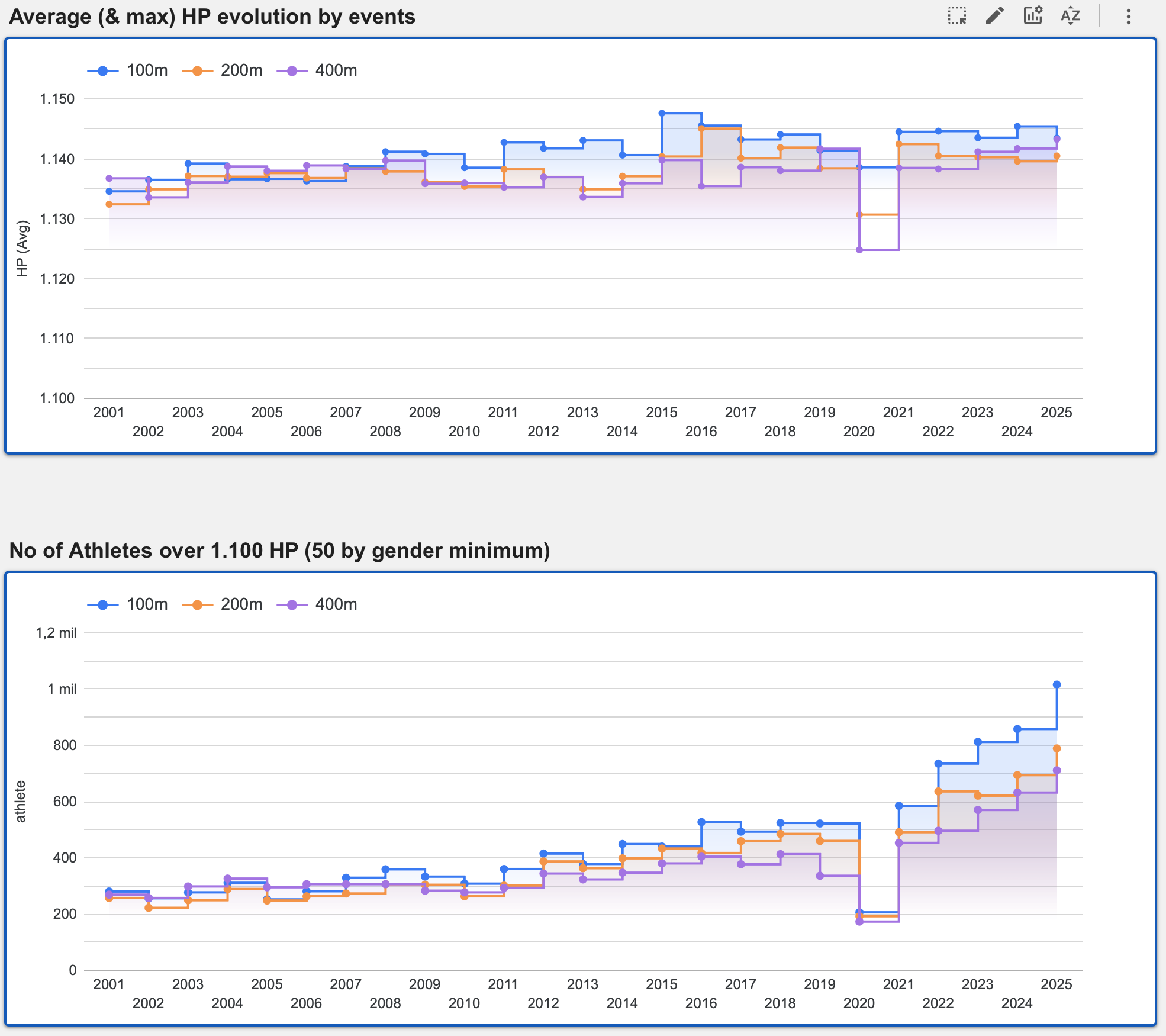
The first chart shows the average results along the time by events. Clicking on the upper bar of the graphic "optional Metrics" you can change Average / Max Hungarian points.
The second chart shows the number of athletes with more than 1100 HP by year in each event. In case of less than 50 by gender, the first 50 by gender are in the graphic.
On average, performance trends have risen slightly in recent years, and the number of athletes exceeding 1,100 Hungarian points has increased clearly.
(Remember that you can filter the data using the dropdown menus above, or by clicking on data points in most charts and tables)
Performance by Countries
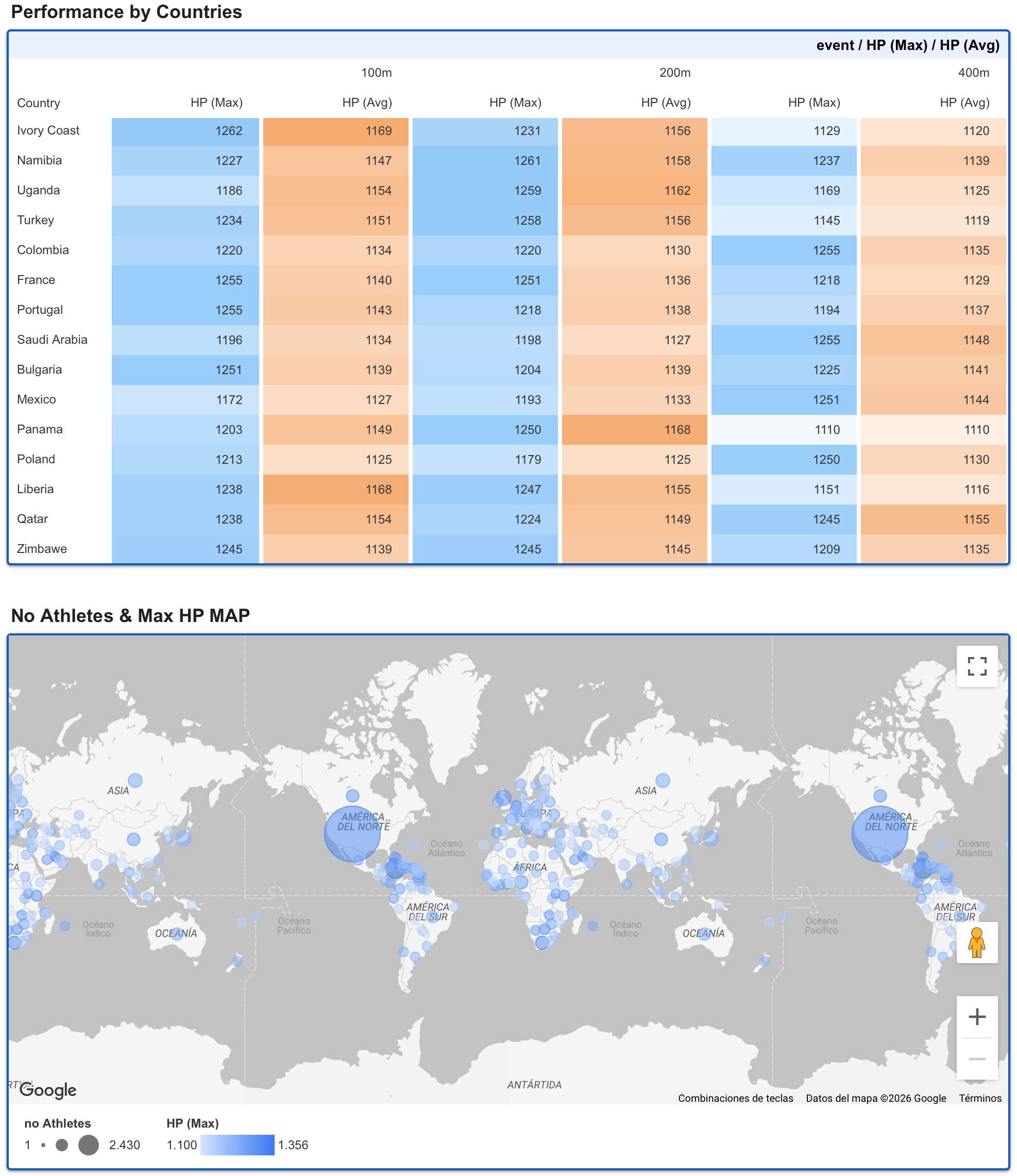
The following table shows each country’s performance in each event, including the average Hungarian points score and the maximum score.
The map below displays the countries, with bubble size representing the number of athletes from each country and the color scale indicating each country’s maximum Hungarian points score. The drop-down menus at the top can be used to filter the view by a specific event.
Here we can see the high level of the United States in terms of athlete numbers, with more than 2,400 athletes exceeding 1,100 points during the analysis period. It also holds two current world records and seven of the top 20 performances.
Jamaica is at a similar—if not higher—level, with two world records held by Usain Bolt and 10 performances in the top 20. More than 500 athletes exceed 1,100 points, representing a proportion considerably higher than that of the United States.
(Remember that you can filter the data using the dropdown menus above, or by clicking on data points in most charts and tables)
PAGE II : SPRINT Events Versus Other Disciplines
On the second page, we compare Sprint events with the other athletics disciplines.
Access to the report (Page II): https://datastudio.google.com/s/orotvRCFY4k
Data Selection Controls

The drop-downs allow you to select one, several or all available options intuitively. The report automatically updates to reflect the selected data.
You can also filter the information by clicking directly on data points in most of the charts and tables throughout the report.
Comparison Across Events: Number of Athletes, Maximum Score, and Average Hungarian Points
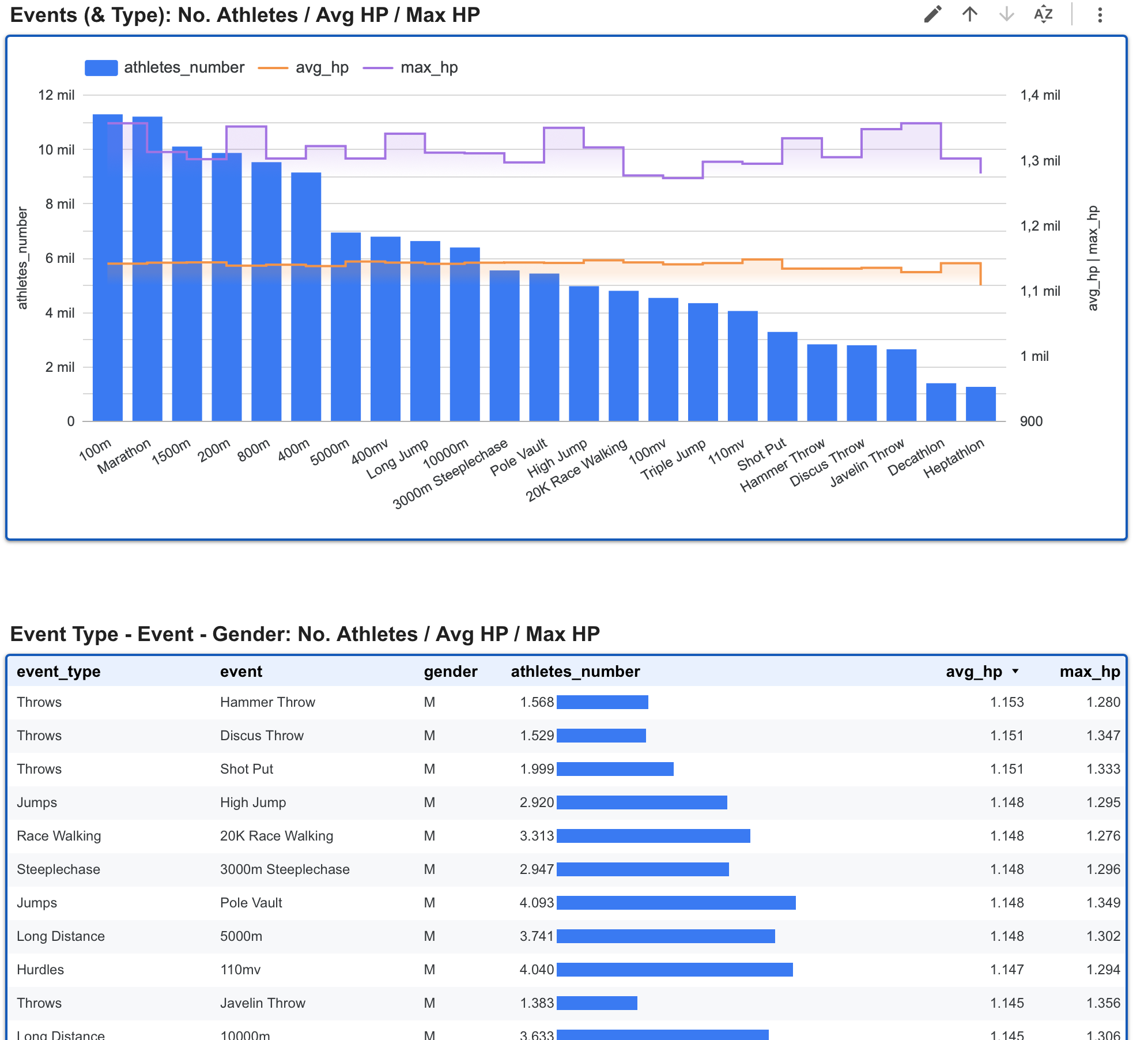
The chart compares the different event categories, including the total number of athletes and the average and maximum Hungarian points achieved during the analysis period (2001–2025). (You can select by events or events type using the arrows on the upper bar)
Sprints rank first in terms of the number of athletes (Please note that sprints comprise three events, whereas other disciplines include more). Selecting by events in the upper bar, we can see 100 meters in the 1st position considering number of athletes. and 200 m in the 5th position.
The following table provides a more detailed breakdown by event - type, event and gender, initially sorted by average Hungarian points in descending order. It highlights the events with the highest average scores among athletes exceeding 1,100 points—or the top 50 athletes where that threshold is not reached.
When sorted by average Hungarian points, the sprint events do not rank among the top positions, likely because a large number of athletes exceed or come close to 1,100 points. However, when sorted by maximum Hungarian points, Usain Bolt’s performances rank second and third, surpassed only by the javelin world record.
Please remember that you can filter these data using the dropdown controls above or by clicking on any of the charts.
Data Trends Over Time (2001–2025)
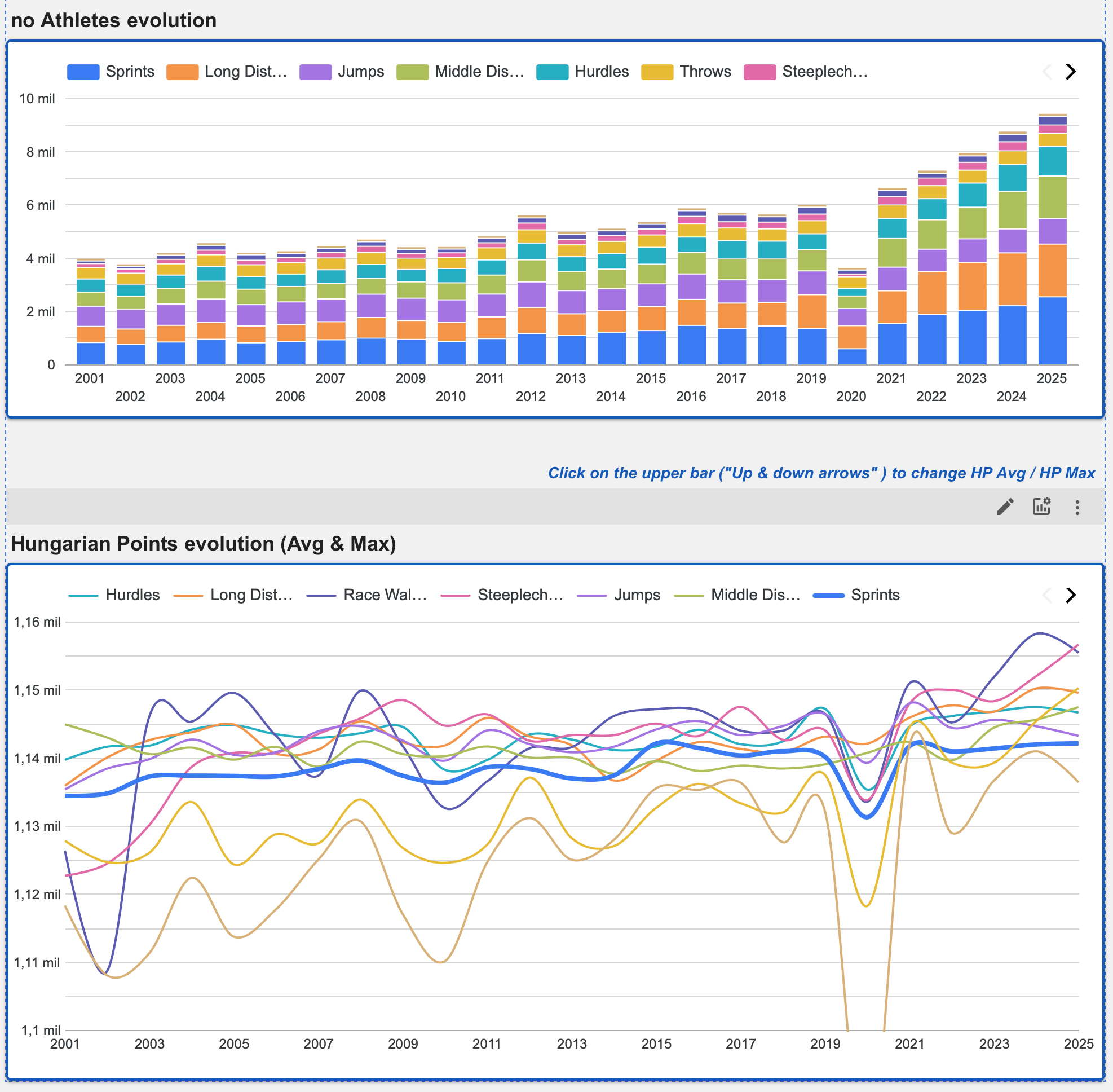
The first chart uses stacked bars to show the number of athletes scoring above 1,100 points—or the top 50 athletes where that threshold is not reached. Excluding the COVID-affected year, athletics shows steady progress in performance quality, while spins events remain as a leader of the ranking. It should be noted that some disciplines include only one event, whereas sprints comprises three.
The second chart shows the trend in average Hungarian points over time. Aside from the COVID-related dip, it also reflects a gradual improvement in performances across all event categories, including sprint events.
Please remember that you can filter these data using the dropdown controls above or by clicking on any of the charts.
PAGE III, IV & V : EVENT DETAILS
The following pages present detailed information on each of the three sprint events. As the format is the same for all of them, we show here Page III, which covers the 100 m. The page IV related to 200 m and page V about 400 m are available through the links
Access Page III (100 m): https://datastudio.google.com/s/p5GakUXkWjE
Access Page IV (200 m): https://datastudio.google.com/s/m_KUCEk72Ek
Access Page V (400 m): https://datastudio.google.com/s/qol9vnS8tjI
Data Selection Controls
The drop-downs allow you to select one, several or all available options intuitively. The report automatically updates to reflect the selected data.
You can also filter the information by clicking directly on data points in most of the charts and tables throughout the report.
100 M Evolution: Number of Athletes, Average / Max Hungarian Points and WR
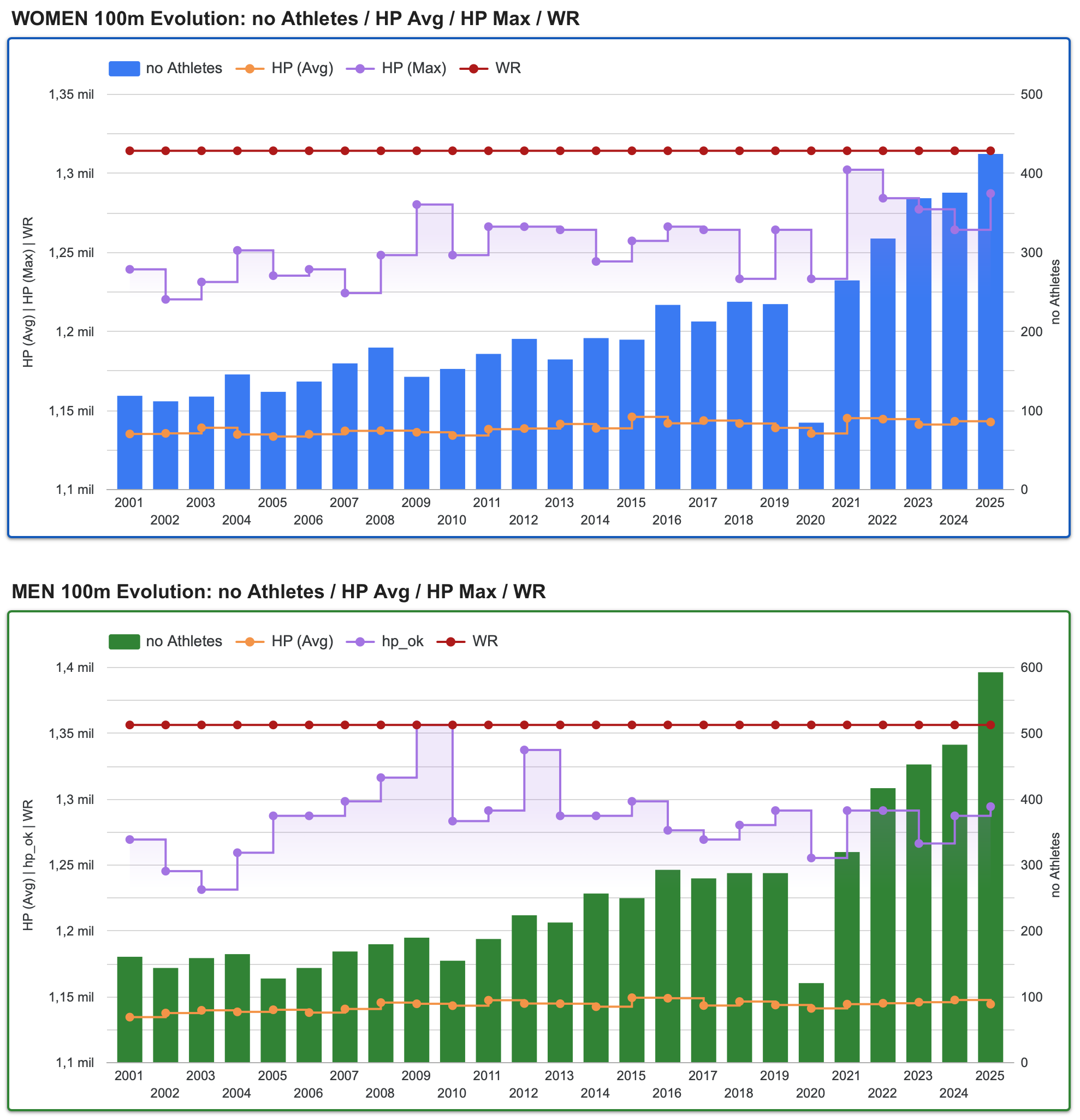
The following two charts show the evolution of the 400 hurdles over the analysis period: the first for female athletes and the second for male athletes. They include the number of athletes, average and maximum Hungarian points, and WR as a reference too
For the women’s event, the increase in athletes exceeding 1,100 points has been remarkable in recent years, reaching 424 in 2025. In recent years, we have also seen an increase in the top performances, with Elaine Thompson-Herah coming close to the world record in 2021.
In the men’s event we see the same pattern as in the women’s category: a sharp increase since the COVID-affected year, and, regarding top performances, Usain Bolt world record in 2009
Please remember that you can filter these data using the dropdown controls above or by clicking on any of the charts.
100 m by Countries
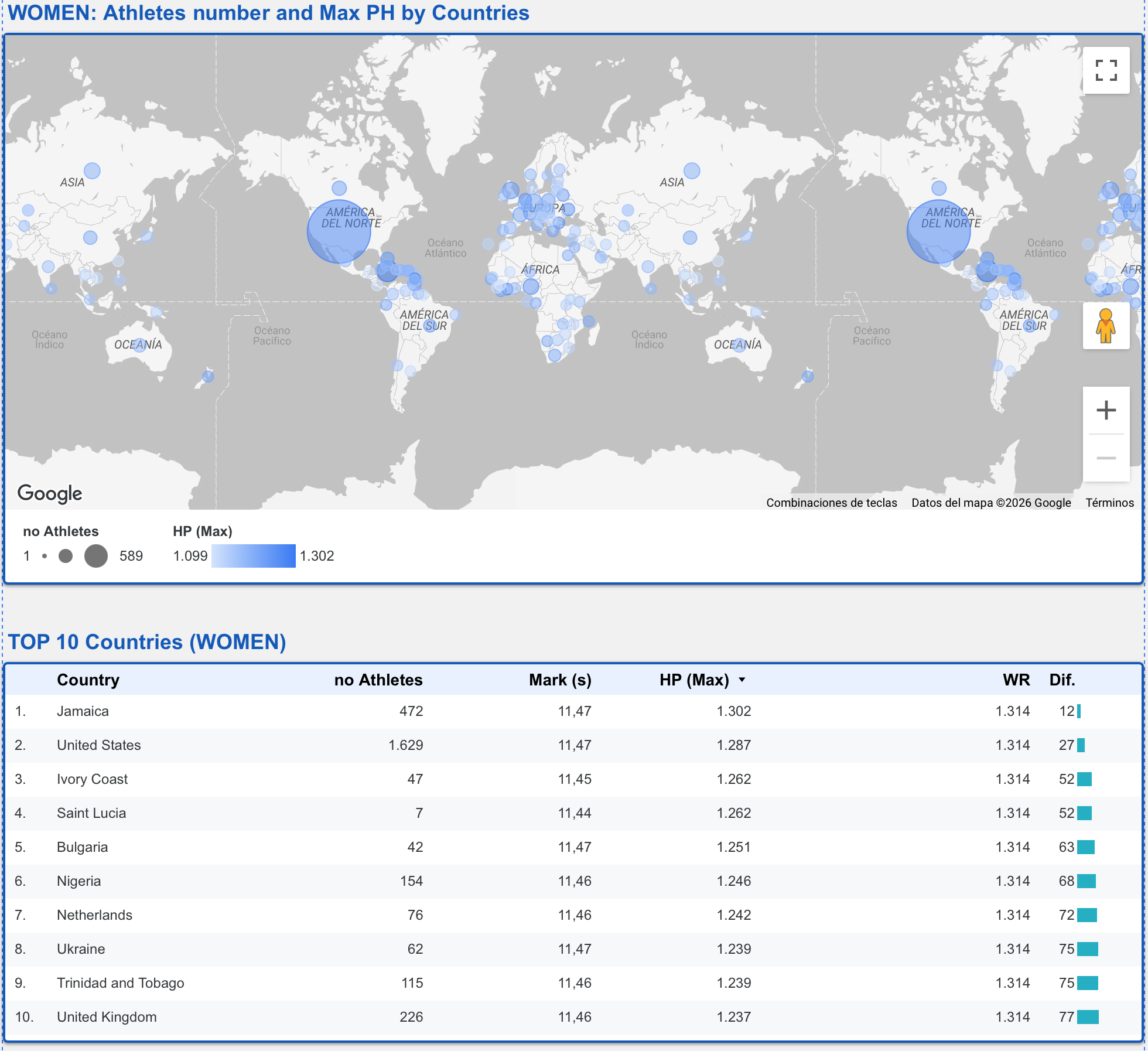
(Only the women’s section is shown in the image as an example)
Here, we present 100 m performance by country, separately for women and men. The maps show the number of athletes within the study period (bubble size) and the highest Hungarian points score achieved (colour intensity).
The tables rank the top 10 countries, showing the number of athletes, best performance, and highest Hungarian points score. They also include the world record and the gap between each country’s best performance and the record, expressed in Hungarian points.
For women, the United States clearly leads with 1629 athletes and the world’s best performance, followed by Jamaica, which ranks second in number of athletes and fourth in best performance.
For men, the same pattern is repeated: the United States dominates, with 1615 athletes and the second-best performance of all time. The best result is for Jamaica, with more than 500 athletes and the world record
Please remember that you can filter these data using the dropdown controls above or by clicking on any of the charts.
100 m by ATHLETES
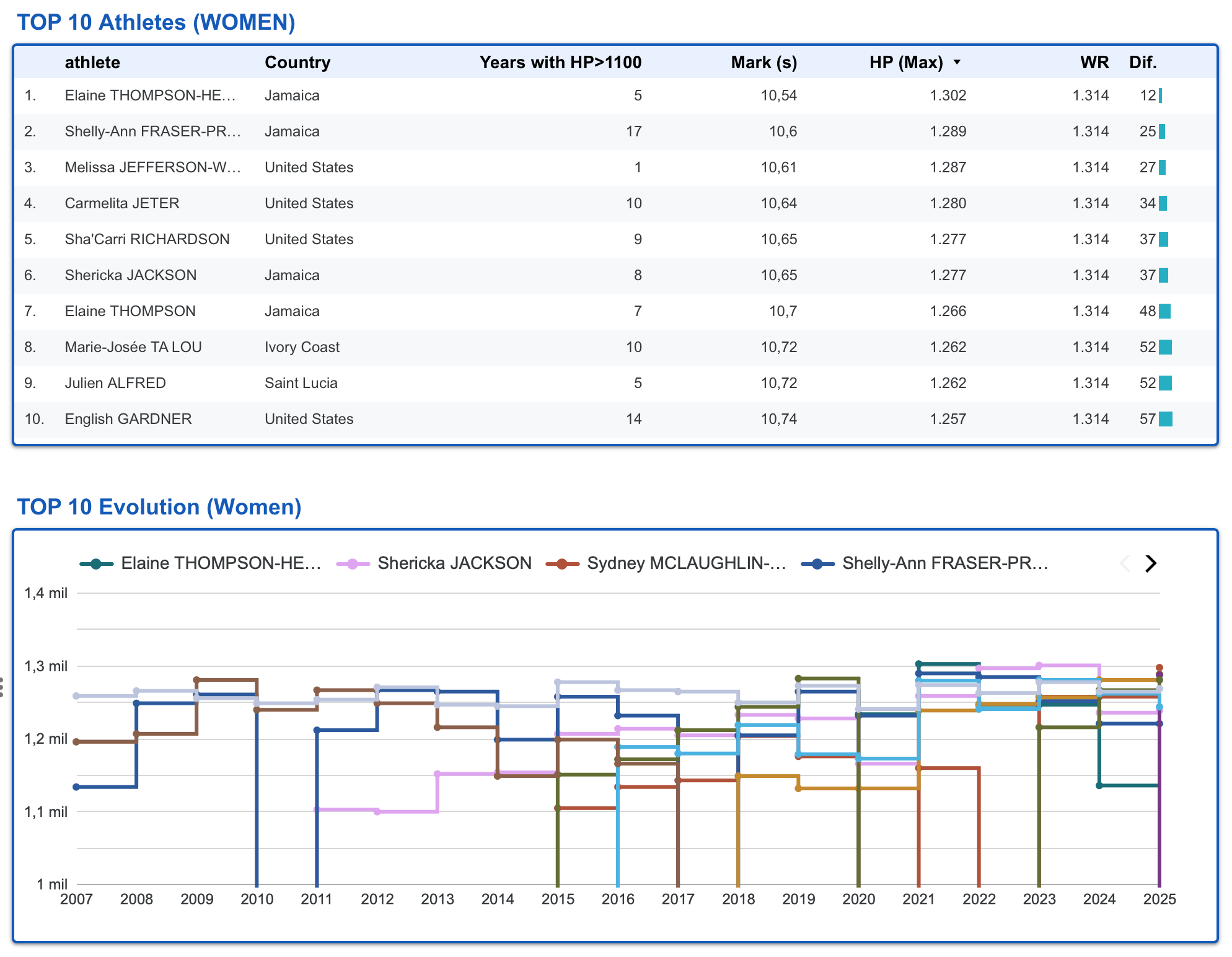
(Only the women’s section is shown in the image as an example)
Here, we present 100 m performance by athletes, separately for women and men.
The first table rank the top 10 athletes, showing the country, t
he years in which the athlete exceeded 1,100 Hungarian points
, best performance, the best mark, and highest Hungarian points score. They also include the world record and the gap between each athlete’s best performance and the record, expressed in Hungarian points.
The following chart shows the progression of the top 10 athletes over the analysis period.
In the women’s category, four American athletes and four Jamaican feature in the top 10, led by the Jamaicans Elained Thompson and Shelly-Ann Fraser, she remained among the athletes exceeding 1,100 points for 17 years.
In the men’s category, Jamaica and the United States dominate the top 10, with five performances each, including Usain Bolt’s world record. Also noteworthy are the long careers of Tyson Gay (17 years), Yohan Blake (18 years), and Asafa Powell (17 years) among athletes exceeding 1,100 Hungarian points.
Please remember that you can filter these data using the dropdown controls above or by clicking on any of the charts.
INTERACTIVE REPORT
The report is embedded here for your convenience. In the shaded toolbar at the bottom of the report, you will find two links: one to open the report in full-screen mode and another to open it directly in Google Data Studio.
For greater flexibility, we recommend opening the report directly in Google Data Studio. It is safe and free to use.
Due to the complexity of the report, we recommend viewing it on a computer, or at least on a tablet.
(in case of use the embedded report, Click on the bottom-left navigation bar to move between the different pages of the report)
CONCLUSION
The data analysed point to excellent health in the sprint events. The overall number of athletes exceeding 1,100 points has continued to grow in recent years. The United States and Jamaica stand out in both athlete numbers and performances, while the 100 m and 200 m events show a particularly strong Caribbean presence.
On the negative side, the women’s world records from the last century still remain unbeaten, unlike the men’s records, despite the outstanding athletes we have seen in recent years.
That’s all for now. We will soon continue with the middle - distance disciplines.. Please notify me any mistake or suggestion about how to improve our analysis.
Any comments or suggestions are very welcome.
Thank you for your attention.
